Public administration reform (PAR) has directly changed citizens’ everyday lives and the way businesses operate, it was concluded at the conference “The Change That Lasts, The Result That Remains”, held on 22 January at EU House, where the most important results of PAR in Serbia and future directions for its development were presented.
Among the lasting results highlighted was that public administration has become more accessible, faster, and more user-oriented, as evidenced by the growing number of citizens using services on the eGovernment Portal.
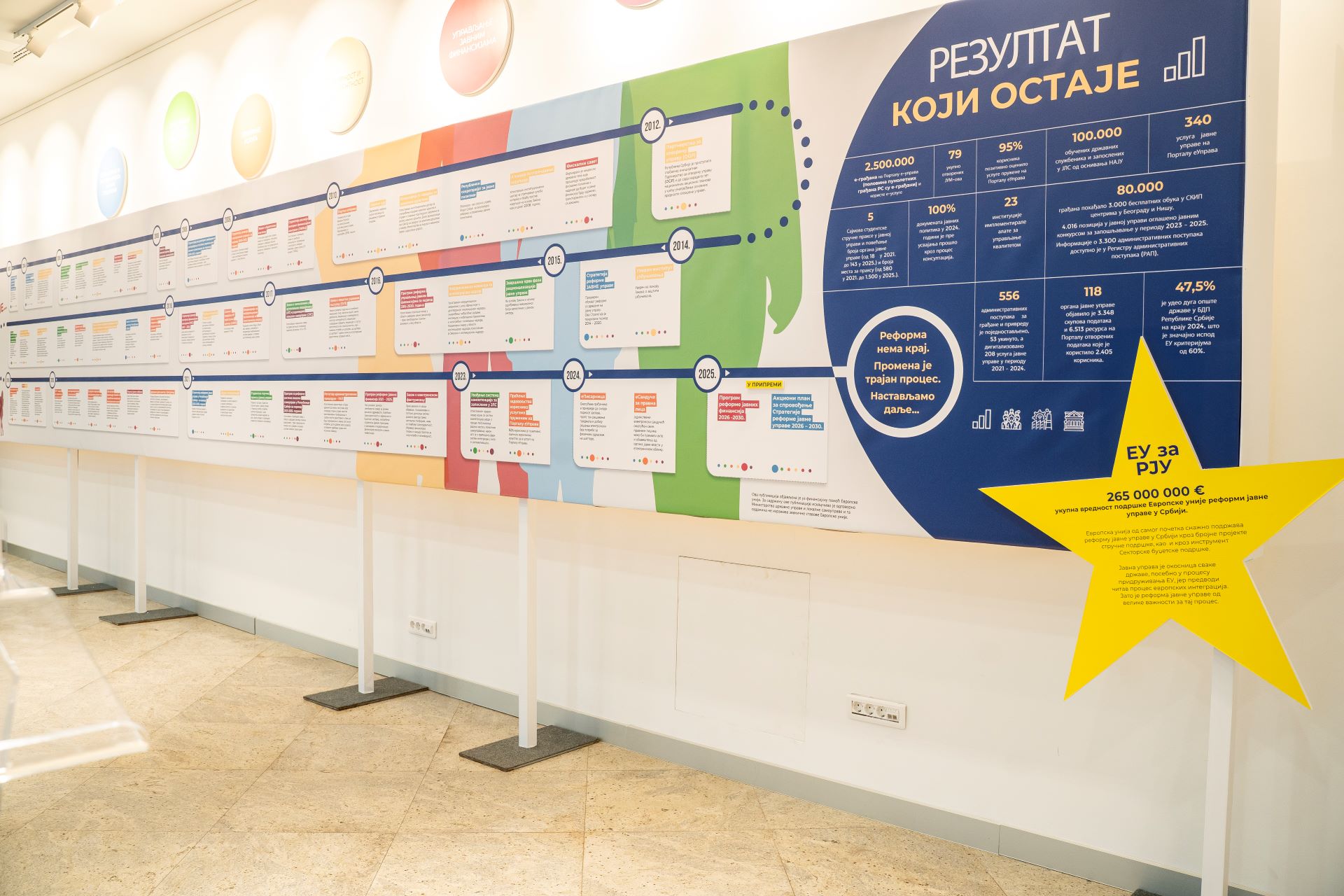
“Today, we have 2.5 million e-citizens, half of Serbia’s adult population, using the eGovernment Portal. The portal offers 340 electronic services, and as many as 95 percent of users rate the services positively,” said Minister of Public Administration and Local Self-Government Snežana Paunović.
She added that 79 One-Stop-Shops have been opened across the country, enabling citizens in local communities to complete several administrative procedures at a single counter. As one of the next steps in developing the “one-stop shop – multiple services” concept, the introduction of mobile One-Stop-Shops was mentioned, in order to bring services closer to citizens in less accessible areas and to the most vulnerable groups.
For the European Union, public administration reform is not a technical side issue but one of the very foundations of the EU accession process, said Deputy Head of the EU Delegation to Serbia, Plamena Halacheva, addressing the audience.
“If the public administration is not professional, predictable, and accountable, reforms in any sector remain incomplete. No country can effectively respond to crises, manage public investments, or deliver services to citizens without a capable administration. Public administration reform is never truly finished: societies evolve, technology advances, and citizens’ expectations continue to raise. The European Union has been a committed and reliable partner in this process from the very beginning and will continue to support public administration reform in Serbia," she concluded.
The working part of the conference, attended by representatives of Serbian institutions, the EU Delegation to Serbia, business, media, and civil society, included three panel discussions. The panel “From Strategy to Reform” focused on the development and implementation of strategic documents in the field of public administration reform; the panel “Future Directions of PAR - What Awaits Citizens and Businesses” addressed expectations for the coming period and improvements in public administration services; while the panel “EU and PAR” focused on the support and role of the European Union in the process of modernising public administration in Serbia.
The event, organised with the support of the EU For Public Administration Reform project (EU4PAR), was accompanied by an exhibition showcasing the results of public administration reform in Serbia, which presented concrete achievements of the reform through visual displays. The exhibition at EU House will be open until the end of January.
How Citizens See Public Administration Reform
Public opinion research on citizens’ awareness of public administration reform, conducted in late 2025 by the EU4PAR project, shows that citizens in Serbia most often interact with public administration for basic services and that their overall experiences are predominantly positive, with high ratings for the courtesy and professionalism of civil servants. “About one third of respondents use e-government services, with very high user satisfaction, and none of the current users plan to stop using them,” said EU4PAR Team Leader Juhani Lemik while presenting the findings. He added that half of citizens are familiar with public administration reform, with digitalisation standing out as its most visible result, although awareness of the European Union’s role as the main donor remains limited. A key challenge identified is the need for stronger support to citizens who do not yet use digital services, due to habits, complexity of procedures, and distrust of e-government services.