About Sector
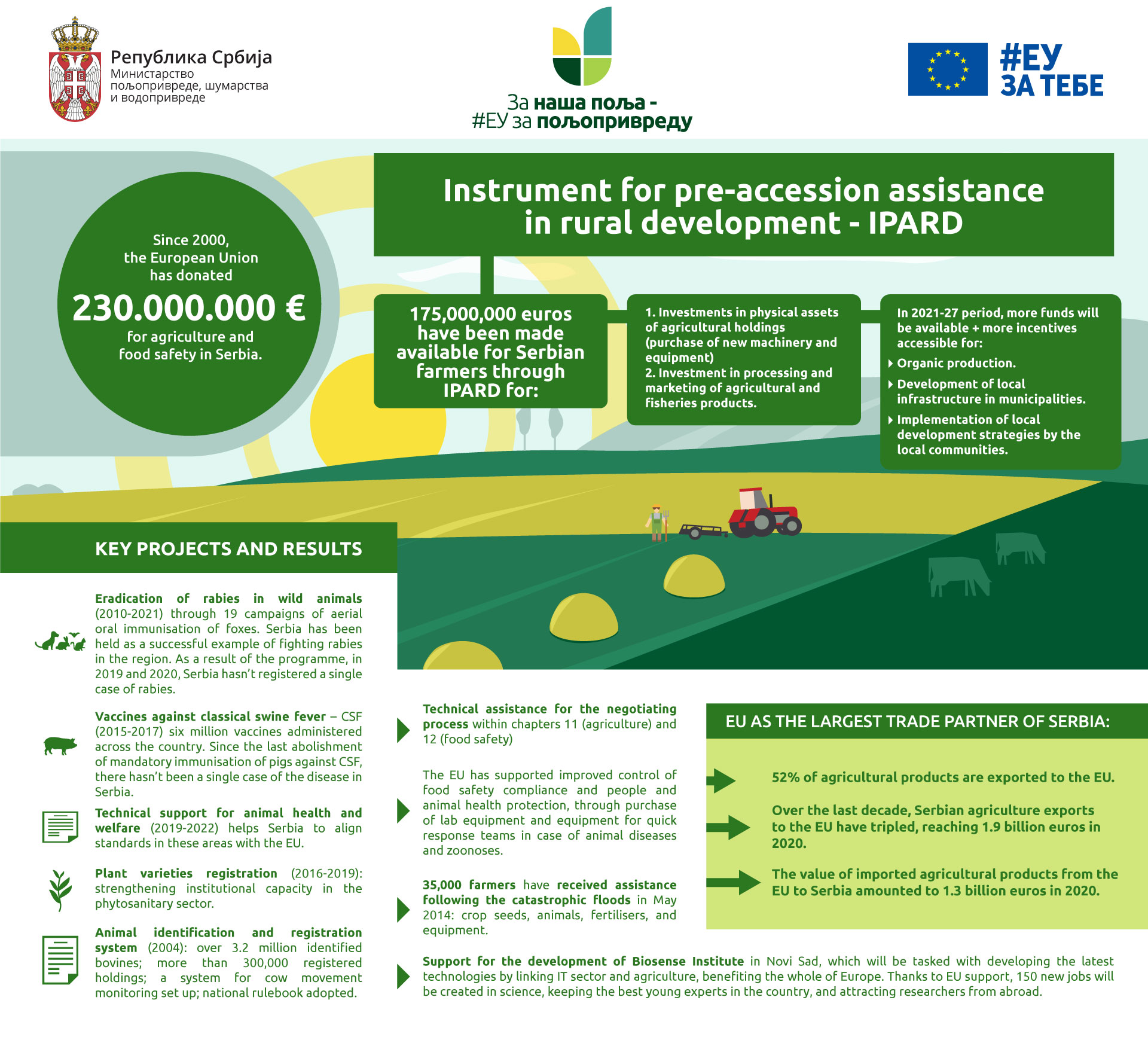
Since 2000, the European Union has donated 230 million euros for agriculture and food safety in Serbia.
Environmental protection and human health protection, food safety, animal welfare, keeping soil in good condition – are the main goals of this sector.
For more than two decades, the EU has been a strategic partner of Serbia in developing the agricultural sector. The value of Serbian agro-exports to the EU rose from €640 million in 2009 to €2.5 billion in 2024. About 50% of total Serbian agro-exports go to the EU market of 450 million consumers.
The EU finances projects in the field of agriculture, food safety, and animal health: rabies eradication, resilience of the agricultural sector to natural disasters, harmonization of production standards and control of fresh poultry meat and eggs, establishment of LPIS systems, as well as the establishment of a common market for agricultural products.
Here are some more significant aspects of this sector:
The Common Agricultural Policy is one of the most important sectors in the EU, both in terms of the number of regulations governing this area and the size of the agricultural budget in the overall budget of the European Union. EU agriculture accounts for almost 40% of the total EU budget. The main objective is to ensure a stable supply of the market for agricultural products at affordable prices, which in turn means adequate income for farmers. The agricultural sector consists of two parts:
- direct payments with market intervention,
- and rural development.
Direct payments imply that, while protecting the environment and human health, food security, respect for animal welfare, keeping the land in good condition, farmers are given incentives regardless of what type of production they are producing and thus have a stable income regardless of market volatility. Market interventions include the withdrawal of products from the market, support for the production of certain products, a quota system, support for farmers in the fruit and vegetable sector. Rural development contributes to strengthening the competitiveness of agriculture and forestry, as well as improving the quality of life of rural areas.
EU projects for farmers in Serbia encourage the use of funds from agriculture and rural development funds, improve product quality, and increase their competitiveness in the EU market. It also strengthens the capacity of the Agency for Agrarian Payments, the body that will be the bridge between Serbian farmers and EU institutions.
IPARD
When it comes to the Republic of Serbia, the agriculture sector is not focused only on harmonization of agricultural policy, that is Chapters 11 and 12 – Agriculture and rural development and Food safety, veterinary and phytosanitary policy. EU assistance is reflected in tangible donations, with the Instrument for pre-accession assistance for rural development (IPARD) serving as the prime example of that assistance. IPARD is the leading programme in this area, with 175 million euros allocated for Serbia for the period 2014-2020, coupled with another 55 million of national funding. It is worth noting that beneficiaries will have these funds at their disposal until 2023.
Within IPARD, Serbia has decided to implement six following measures:
- Investments in physical assets of agricultural holdings (Measure 1)
- Investments in physical assets concerning processing and marketing of agricultural and fishery products (Measure 3)
- Eco-oriented and organic farming (Measure 4)
- Implementation of local development strategies — LEADER approach (Measure 5)
- Measure 7 - Diversification of agricultural holdings and business development: aims to increase the level of development of economic activities in rural areas, with the possibility of creating new jobs, which will directly increase the income of farms
- Diversification of agricultural holdings (Measure 9)
The IPARD III Programme for the Republic of Serbia forthe period 2021 - 2027 was adopted by Decision of the European Commission No. C(2022)1537 of 9 March 2022. Compared to the previous programming period, the financial contribution of the European Union for the IPARD III Programme is increased to EUR 288 m, which with the contribution of the Republic of Serbia and the private contribution of recipients, will provide over EUR 580 m of support to the agriculture and rural development sector.
The European strategy Farm to Fork is particularly noteworthy: it aims to secure availability of healthy food and affordable food prices for all Europeans. Furthermore, the strategy aims to achieve multiple benefits: preserve biodiversity, fight climate change, develop organic food production.
List of key local partners/organisations
- Ministry of European Integration
- Ministry of finance
- Ministry of Agriculture, Forestry and Water Management
- Ministry of Labour, Employment, Veteran and Social Policy
- Republic Geodetic Authority
The support of the European Union to the agriculture and rural development in Serbia is more than EUR 230 million worth from 2000 until now. The funds are used for increasing the competitiveness of agricultural holdings, companies and manufacturing capacities using the IPARD program, welfare and health control of the animals, maintaining the good condition of the soil, establishing the national referential laboratories, ensuring the overall food safety, harmonization of agricultural policies, as well as the preparation of the public management for the application of the standards of the EU.
The EU projects of this sector encourage the use of assets from the funds for agriculture and rural development, improving the quality of produce, ensure the encouragement and increase the competitiveness of Serbian farmers at the European Union market with over 450 million consumers.
The support from the European Union is implemented in cooperation with the Serbian Government. The European Union is the biggest donor out of all other international donators put together. The donations from the European Union are used for Serbia`s development.